Florida Accident Law | Comparative Fault
What Happens If Multiple Parties Are at Fault in a Florida Accident?
Florida Modified Comparative Fault Explained
Updated May 25, 2026 | Robert J. Johnson Law | Tampa and Central Florida Injury Claims
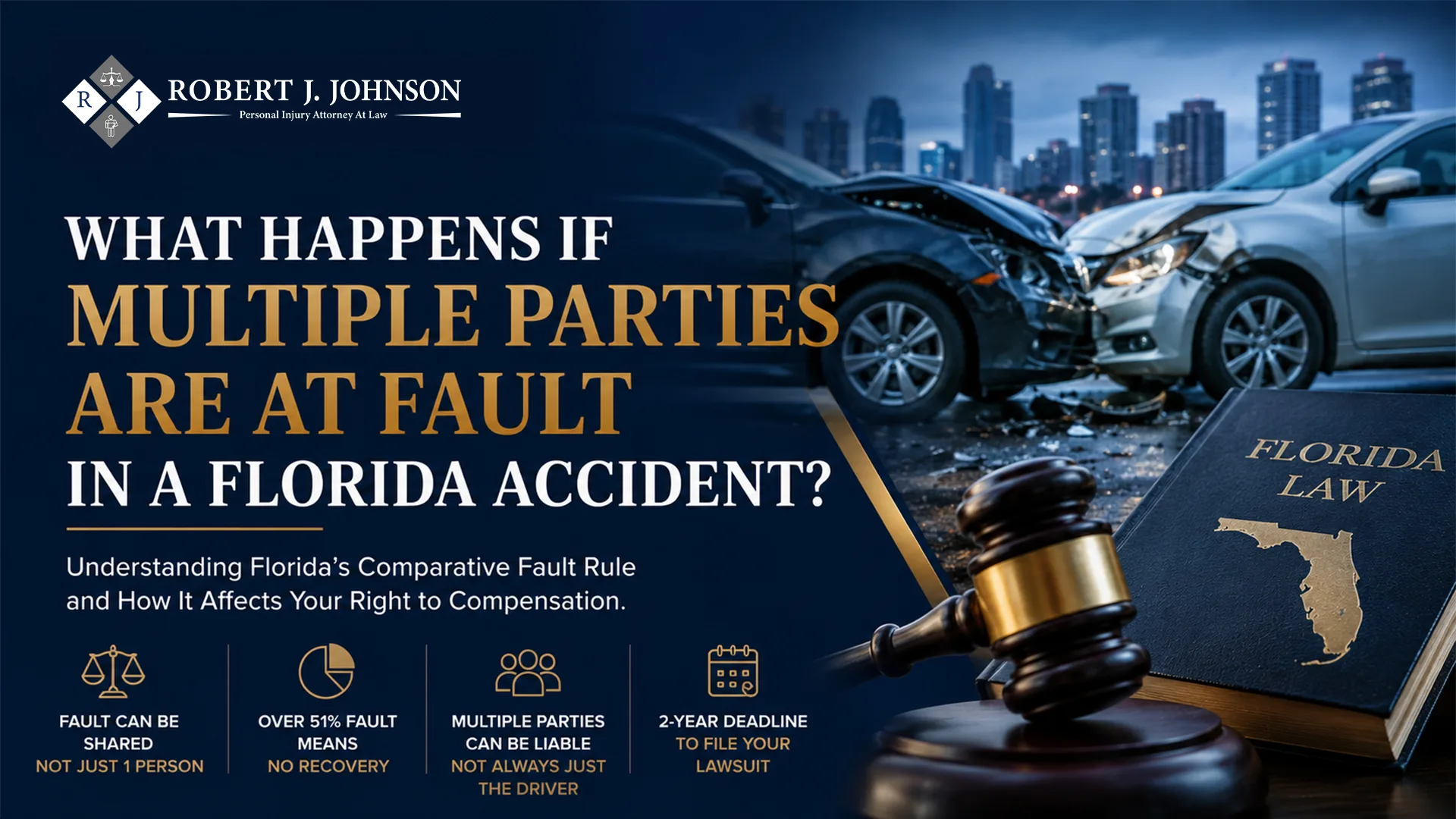
The rules changed in Florida in 2023 because of tort reform. If more than one person is at fault for your accident, your right to compensation now depends on how much fault is assigned to you. If your share stays at or below 50%, you may recover damages reduced by your percentage of fault. If you are found 51% or more at fault, you may recover nothing.
Key Points
- In March 2023, Florida changed from pure comparative negligence to modified comparative fault.
- If you are more than 50% at fault, Florida law can block your injury recovery.
- Multiple defendants usually pay only their individual share of fault.
- The personal injury statute of limitations for most Florida negligence claims is now two years.
- Insurance adjusters often assign blame strategically to reduce settlement payouts.
Maximum plaintiff fault share that may still allow reduced recovery
Fault level that can bar compensation under Florida's modified rule
Years to file most Florida negligence injury lawsuits after HB 837
Did Florida Change How Fault Works in Accidents?
Yes. Florida used pure comparative negligence until March 24, 2023. Before that date, a driver who was 99% at fault could still pursue 1% of their damages. That system is no longer the rule for most negligence cases.
On March 24, 2023, HB 837 created a modified comparative fault system with a 51% bar rule. Florida's comparative fault statute, Florida Statute Section 768.81, controls how fault is allocated in many civil negligence cases.
How Courts Decide Who Is at Fault and by How Much
In multi-party accident cases, Florida courts and juries review every involved party and assign each one a fault percentage. The total must add up to 100%. That analysis can include drivers, businesses, vehicle owners, property owners, contractors, and government agencies.
| Fault Factor | Evidence Used |
|---|---|
| Speed at time of collision | Police reports, skid marks, dashcam footage |
| Distracted driving | Phone records, eyewitness accounts, surveillance footage |
| Road and weather conditions | Traffic camera footage, FDOT weather data |
| Vehicle maintenance failures | Inspection records, brake failure analysis |
| Traffic law violations | Citations, red light camera records |
| Driver history | License records, DUI history, prior convictions |
Florida records hundreds of thousands of traffic crashes in a typical year. The Florida Department of Highway Safety and Motor Vehicles publishes crash data that shows how common serious crash investigations are across the state.
Every 10% of Fault Can Change the Value of Your Claim
Insurance adjusters run their own fault-assignment process. Their goal is not always accuracy. Every additional percentage assigned to you can reduce the recovery they have to pay.
What If You Are Partly at Fault in the Accident?
The answer often turns on one number. If your fault is between 0% and 50%, you can still recover damages, but the award is reduced by your share. If your fault reaches 51% or more, Florida law can prevent any recovery.
Reduced Recovery Available
A $100,000 case with 30% plaintiff fault becomes a $70,000 recovery.
Recovery Barred
A jury finding of 52% fault can turn the same $100,000 case into no compensation.
Can You Sue Multiple Defendants at the Same Time?
Yes. Florida allows injured people to name every at-fault party in one lawsuit. The court apportions fault among them, and each defendant generally pays only that defendant's own share. This is several liability, not joint and several liability.
This rule makes early investigation critical. If one responsible party is missed, that missing party's share of your damages may become difficult or impossible to recover.
Chain Collision Scenario: I-95 Pileup
- Driver A rear-ends Driver B and is assigned 60% fault.
- Driver B is pushed into Driver C and is assigned 30% fault.
- Driver C is assigned 10% fault as the injured claimant.
- On $200,000 in damages, Driver A pays $120,000, Driver B pays $60,000, and Driver C recovers $180,000 total.
What Most Accident Victims Get Wrong
Our review of multi-party accident claims showed a clear pattern: injured people often accept the insurer's fault decision too early. An insurance fault assignment is not a verdict. It is an opening position in a negotiation.
Accepted the insurer's first fault decision without challenge
Average reduction in first settlement offers vs. final recovery
Multi-party cases had at least one liable party overlooked
Believed partial fault meant they had no case at all
“I have seen clients leave six-figure settlements on the table because they assumed partial fault meant no recovery. Florida law protects your right to compensation even when you share responsibility. The question is never whether you can recover. It is how much.”Attorney Robert Johnson, Florida Personal Injury Lawyer
Accidents That Often Involve Multiple At-Fault Parties
Multi-party liability is common in cases where several choices, safety failures, or business responsibilities combine to cause harm.
| Accident Type | Common Parties at Fault |
|---|---|
| Multi-vehicle highway pileup | Multiple drivers, road design or signage entities |
| Rideshare accident | Driver, rideshare platform, other motorists |
| Construction zone crash | Contractor, government agency, other drivers |
| Commercial truck accident | Driver, trucking company, cargo loader |
| Slip-and-fall at a business | Property owner, maintenance company, product maker |
| Defective vehicle accident | Other driver, vehicle manufacturer, parts supplier |
The National Highway Traffic Safety Administration notes that large truck crashes can involve complex safety issues. In one collision, the driver, trucking company, shipper, cargo loader, maintenance provider, or vehicle manufacturer may need to be investigated.
How to Protect Your Compensation After a Multi-Party Accident
Speed matters. HB 837 shortened the limitations period for most Florida negligence injury claims from four years to two years. Multi-party cases also need fast evidence preservation because each insurer may try to shift blame to someone else.
Step 1
Call 911 and get a police report as the first official record.
Step 2
Seek medical attention within 14 days to help protect Florida PIP benefits.
Step 3
Document vehicle damage, injuries, witness names, roadway conditions, and dashcam footage.
Step 4
Avoid recorded statements to any insurance company before legal review.
Step 5
Contact an attorney early so evidence and liable parties can be identified before the case weakens.
The Florida Bar offers consumer guidance on hiring and speaking with an attorney. In multi-party claims, early legal help can protect evidence, identify additional defendants, and reduce the risk that fault is unfairly assigned to you.
Talk to a Florida Personal Injury Attorney Before Fault Is Locked In
In multi-party accident cases, the first 48 hours can be the most valuable. Evidence is fresh, witnesses remember details, and insurers have not yet built their blame-shifting positions.
Frequently Asked Questions
What is the 51% rule in Florida?
Florida's modified comparative fault law says that if you are found 51% or more at fault for an accident, you generally cannot recover injury compensation. The rule replaced pure comparative negligence for most negligence cases after March 24, 2023.
Can I sue more than one person after a Florida accident?
Yes. You can name multiple defendants in one lawsuit. The court or jury assigns each party a percentage of fault, and each defendant is generally responsible only for that defendant's own share.
What if one of the at-fault drivers has no insurance?
You may be able to use your uninsured motorist coverage. A lawyer can also investigate whether another responsible party, such as a trucking company, property owner, maintenance contractor, or product manufacturer, has available insurance.
Does Florida no-fault insurance still apply in multi-party accidents?
Yes. Florida PIP coverage can still pay certain medical bills and lost wages up to policy limits first. After that, comparative fault claims against responsible parties may be needed for additional damages.
How long do I have to file a multi-party accident lawsuit in Florida?
Most Florida negligence injury claims must be filed within two years after the accident under the post-HB 837 deadline. Evidence disappears over time, so waiting can also make fault harder to prove.
What if a government agency is partly at fault?
Government liability claims follow separate rules, including pre-suit notice requirements and special time windows. Speak with a Florida personal injury attorney quickly if a public agency may share responsibility.
Disclaimer: This article is for general informational purposes and does not create an attorney-client relationship. Laws and filing deadlines can depend on the exact facts of your case. For legal advice about a Florida accident claim, contact Robert J. Johnson Law.